
Wellness Library · Nutrition
What Does Your Body Really Need as You Age?
Understanding protein, vitamins, minerals, and why nutrition is never one-size-fits-all.

You may have heard that you should eat more protein, take vitamin D, or pay closer attention to calcium as you get older. Maybe you've looked at a nutrition label and wondered who decided you needed that particular amount in the first place.
It's a fair question. Two women can be the same age and have very different daily routines, appetites, health concerns, and nutritional needs. One may spend much of her day sitting. Another may be on her feet from morning until night. One might be recovering from an illness; another could be learning to lift weights for the first time.
So where do those daily recommendations come from—and how much should you rely on them?
The numbers are a starting point, not your personal prescription
Researchers develop Dietary Reference Intakes (DRIs) by reviewing evidence about how much of a nutrient people generally need. That evidence can include controlled feeding studies, nutrient-balance research, blood measurements, and clinical outcomes. The resulting recommendations are usually grouped by age, sex, and life stage. [1, 2]
Here are four terms you might come across:
- Estimated Average Requirement (EAR): an intake estimated to meet the needs of half of a healthy group.
- Recommended Dietary Allowance (RDA): an intake designed to meet the requirements of nearly all—about 97–98%—of a healthy group.
- Adequate Intake (AI): a useful estimate when there isn't enough evidence to establish an RDA.
- Tolerable Upper Intake Level (UL): an amount above which the risk of harmful effects may increase. It's a safety boundary, not a goal to reach.
An RDA isn't the exact amount your body uses on any given day. It is a reference point intended to help people plan nutritionally adequate diets over time. A nutrition label's % Daily Value is another broad labeling tool, not a personalized prescription. [1, 2]
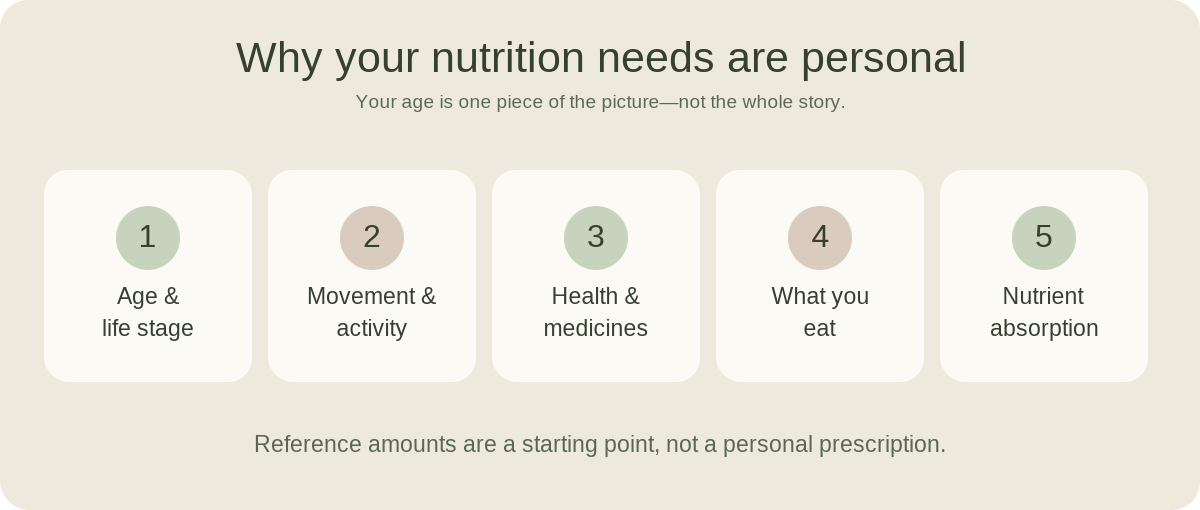
What makes your needs different from someone else's?
Your body size, age, activity, health, medications, hormonal changes, and eating pattern all matter. So do the amount of food you're able to eat and how well your digestive system absorbs nutrients. The factors that matter most can differ depending on the nutrient.
Genetics can play a part, too. Certain inherited conditions significantly change how the body handles nutrients. Common genetic variations can also influence processes such as lactose digestion or iron regulation. But having a DNA result doesn't mean we can calculate your ideal intake of every vitamin or mineral. Studies have not yet established that adding routine commercial genetic testing to nutrition counseling consistently improves health outcomes. [3]
You don't need a DNA test to begin paying attention to what supports your body. Your food choices, symptoms, medical history, and—when appropriate—laboratory findings often provide more practical guidance.

Protein: enough for your life, not someone else's number
Protein helps your body maintain and repair tissues, including muscle. That becomes particularly relevant with age because some people experience gradual loss of muscle mass and strength, especially when they aren't using their muscles against resistance.
The standard adult RDA is 0.8 gram of protein per kilogram of body weight daily. It's based in part on research estimating the intake needed to maintain protein balance. It isn't automatically the ideal amount for every activity level or muscle-building goal. Some expert groups recommend higher intakes for adults over 65 to support muscle and function, but those recommendations are not automatic prescriptions for women in their 40s or 50s. The best target depends on health, body size, activity, and the evidence being considered. [1, 4]
You don't need to eat meat at every meal. Fish, poultry, eggs, yogurt, soy foods, beans, lentils, and nuts all contribute protein. The amount matters, but so does eating enough overall. If you aren't consuming sufficient energy, some dietary protein may be used to help meet energy needs rather than support muscle maintenance.
What if you eat only twice a day? That's not automatically a problem. Two substantial meals may meet your needs; two very small meals may not. Look at what the meals actually contain, not just the number of times you eat.
The vitamins and minerals worth understanding
These nutrients don't suddenly become important on your fiftieth birthday. But changes in bone health, food intake, and absorption can make some especially worth reviewing in midlife and beyond.
| Nutrient | Why it matters | Food sources to consider | U.S. reference intake for women 51–70* |
|---|---|---|---|
| Calcium | Helps maintain bones and supports muscle and nerve function | Yogurt, milk or fortified alternatives, calcium-set tofu, canned fish with edible bones | 1,200 mg/day (RDA) |
| Vitamin D | Helps the body absorb calcium and supports bone health | Fortified foods, some fish; sunlight contributes but varies widely | 15 mcg / 600 IU per day (RDA) |
| Vitamin B12 | Supports nerves and healthy red blood cells | Fish, eggs, dairy, meat, fortified foods | 2.4 mcg/day (RDA) |
| Iron | Helps carry oxygen in the blood | Meat, beans, lentils, fortified grains; vitamin C helps absorb plant iron | 8 mg/day (RDA) |
| Magnesium | Involved in muscle, nerve, and metabolic function | Nuts, seeds, legumes, whole grains, leafy greens | 320 mg/day (RDA) |
Reference values are for generally healthy women in this age group and are not individual prescriptions. Some conditions, medications, and dietary patterns call for different guidance. [5, 6, 7, 8]
After menopause, iron requirements usually decrease because menstrual blood loss has stopped. But that doesn't mean iron can be ignored—or that taking iron 'just in case' is a good idea. If iron deficiency is confirmed after menopause, the cause should be investigated rather than automatically attributed to diet.
Vitamin B12 offers another example of why intake and absorption aren't the same. Some older adults have difficulty absorbing B12 from food, particularly with certain gastrointestinal conditions or medications. Eating enough on paper doesn't always guarantee that enough reaches the body. [5]
And although supplements can be useful when there is a specific need, more is not always better. Excess supplemental amounts of some nutrients can cause harm or interact with medications. [1, 5]

Nourishment is about more than a list of numbers
You deserve advice that considers your actual life. You might be living with a chronic condition, managing a limited appetite, moving through menopause, using a wheelchair, starting to exercise again, or simply trying to make meals feel less complicated. There isn't one body type you must have before healthy eating becomes worthwhile.
A balanced meal doesn't need to be elaborate. It might be rice with tofu and vegetables; fish, potatoes, and greens; eggs with whole-grain toast and fruit; or a hearty bean soup. What matters is variety over time, enough food to meet your needs, and a pattern that works for your health and circumstances.
Try noticing a few things without turning meals into a math assignment: Do you feel comfortably satisfied? Are you maintaining strength for the activities you care about? Are you regularly getting foods that provide protein, calcium, fiber, and other nutrients? Have your appetite, weight, or energy changed unexpectedly?
Unintentional weight loss, persistent fatigue, or new weakness deserves a conversation with a healthcare professional, even if you eat nutritious foods. A registered dietitian can help assess your usual intake and tailor suggestions to your health and preferences.
Food and strength belong in the same conversation
Nourishment helps provide the building blocks for muscle. Strength training gives those muscles a reason to adapt. Neither requires perfection, and you don't have to choose between walking, Pilates, and weights. They can each serve a different purpose.
If you're curious about starting, our companion article Starting Strength Training Without Feeling Overwhelmed explores how to begin at home, in a class, or at a gym. Its printable guide, Your First Strength Session, offers gentle movements you can try at your own pace, with easier options and clear demonstrations.
A thoughtful place to begin
Rather than chasing a perfect number, choose one useful question: Is the way I'm eating helping me feel nourished and capable of doing the things that matter to me?
You don't need every answer today. A little more awareness—and a willingness to adjust when your needs change—can be a meaningful place to start.
Sources you can explore
- NIH Office of Dietary Supplements, Nutrient Recommendations and Databases: https://ods.od.nih.gov/HealthInformation/nutrientrecommendations.aspx
- National Academies, What Are Dietary Reference Intakes?: https://www.ncbi.nlm.nih.gov/books/NBK45182/
- Academy of Nutrition and Dietetics, Incorporating Genetic Testing into Nutrition Care: https://pubmed.ncbi.nlm.nih.gov/32624395/
- National Institutes of Health, Dietary protein and older adult nutrition / broader research context: https://pubmed.ncbi.nlm.nih.gov/23867520/
- National Institute on Aging, Dietary Supplements for Older Adults: https://www.nia.nih.gov/health/dietary-supplements
- NIH Office of Dietary Supplements, Iron: https://ods.od.nih.gov/factsheets/Iron-HealthProfessional/
- NIH Office of Dietary Supplements, Vitamin D: https://ods.od.nih.gov/factsheets/VitaminD-HealthProfessional/
- National Institute on Aging, Vitamins and Minerals for Older Adults: https://www.nia.nih.gov/health/publication/whats-your-plate/vitamins-minerals
- American College of Sports Medicine, 2026 Resistance Training Position Stand: https://pmc.ncbi.nlm.nih.gov/articles/PMC12965823/
Editorial note: This article is for general education, not a diagnosis or individualized treatment plan. Nutrient needs and exercise recommendations can change with medical conditions, pregnancy, medications, and other circumstances. No supplements or changes to prescribed care should be made solely on the basis of this article.
Educational information only. Nutritional needs vary; seek individualized advice where needed.